



By Thembelihle Ngcai

Listen to this Article
There is a particular kind of panic that sweeps through your body when someone slips past your guard. Not the common panic of attraction, not the flirtatious dizziness people write songs about — a deeper panic. The kind that belongs to those of us who have had to build our hearts inside fortresses. The kind familiar to disabled women who learned early that romance can wound you in ways far quieter, far more private, than the world imagines.
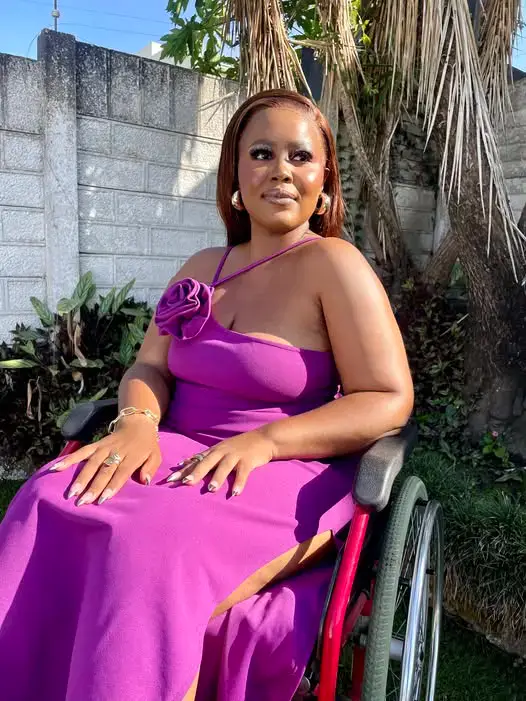
I am thirty-one, Black, and a woman with a degenerative disability. I use a wheelchair in a country where accessibility is a prayer, not a guarantee. I am successful, worldly, the type whose life bends in unusual directions — 3am strategic calls with Geneva, Ambassadors holding the lift at the mall, astrologers texting me about Saturn transits unprovoked. I live in a small coastal city better known for holiday traffic than global thinking, yet I am always in orbit with people whose passports and politics demand stamina.
You would think that kind of life would make me bold in love. You would think that someone who speaks on international stages would be unafraid of vulnerability. But the truth is less glamorous: disability and dating have a way of marking you with a quiet suspicion. You learn to prepare for disappointment, to read the micro hesitations, to anticipate the exit that inevitably arrives disguised as kindness. Over time, you mistake your vigilance for personality.
So you build walls. Not glass ones. Stone.
Then life — mischievous, irreverent life — sends someone into your orbit who sees you before you have fully arranged your mask. And that is when everything you thought you knew becomes unreliable.
It happened to me recently. A man I met in a professional setting — fluorescent lights, neutral carpet, nothing romantic at all. Someone whose presence was so unexpected that my body clocked it before my brain did. This was not the kind of man who studies disability literature or frames his interest in the language of “inclusion.” He met me as a woman first. A mind. A match. There was no performance in it. No spectacle. Just presence — confident, mildly amused, unbothered by the wheelchair that usually turns people into philosophers or cowards.

The connection startled me. Not because it was dramatic, but because it was clean. And if you have dated with a disability long enough, clean attraction is disarming. We are used to affection that arrives with footnotes, hidden conditions, delayed withdrawals, or, worse, the kind of fetishisation that masquerades as desire but recoils when met with reality.
But this? This felt like recognition.
Yet recognition can be frightening. I found myself toggling between longing and self-protection with Olympic speed. One part of me wanted to tell him everything — my thoughts, my fears, the intimacy of a woman who overthinks her way through everything until she lands in a soft, resigned “Anyway, yeah.” Another part of me whispered that I am too much, that the risk is too high, that people leave because people always leave.
It is astonishing how quickly the past resurrects itself when possibility stands too close.
Here lies the conflict that many disabled women experience but rarely name:
We are taught to survive disappointment, not desire.
We know how to endure abandonment.
We do not know how to receive sincerity without dissecting it until it dies.
What complicates it further is that when someone reaches over your walls, they meet the version of you that you rarely show — the hopeful one, the silly one, the woman with desires too large for the geography of caution. You want to laugh with him without rehearsing it. You want to say “kiss me goodbye properly” without swallowing the words. You want to be ridiculous, human, willing, unarmoured.
But self-sabotage is a well-intentioned liar.
It says: I am protecting you.
What it means: I am repeating the past.
And so the walls remain, long after the danger has gone.
But here is what I am beginning to learn — what I hope to offer as a nudge, not a sermon.
The walls we build as disabled women are not weaknesses. They were necessary. They protected us from the indignities of people who considered us inspirational before desirable, symbolic before human. But every protective mechanism has an expiry date. A wall that once saved you can later imprison you.
And if someone reaches over that wall with sincerity — not pity, not saviourism, not spectacle — what exactly are you protecting yourself from in 2025? Whose ghost are you still arguing with? Whose rejection are you still devoting energy to that they never earned?
Your value was never determined by who failed to value you.
Your desirability is not a historical record; it is a current reality.
Your softness is not a liability; it is a human right.
And this applies to everyone: disabled, non-disabled, male, female, queer, questioning, widowed, divorced, re-emerging after heartbreak, or simply emotionally exhausted.
The question is simple, though uncomfortable:
If your guard remains higher than its purpose, who do you end up with in the end?
Guard your honour. Guard your dignity. Guard the parts of you that have been mishandled. But ask yourself whether you are guarding your life so ferociously that joy no longer knows where to enter.
Maybe the person you meet tomorrow will not be the person you end up with. Maybe the man under the fluorescent lights was just a season. Maybe the one who made you feel everything in a single moment will become a tender footnote. Or maybe he will be the opening act to a life you do not yet have language for.
Either way, allow yourself the possibility of being surprised. The universe — or astrology, if you trust the stars as I do — has a habit of giving you what you refused to imagine.
And if someone slips past your guard?
Do not panic.
Do not over-explain.
Do not run.
Let yourself feel the tremor of being seen.
Feel it fully.
Feel it fearfully.
Feel it anyway.
Because the love you think you are protecting yourself from may be the very thing trying to reach you.
Connect With Thembelihle Ngcai