







By Devika Desai

Listen to this Article

Scott Martin had always been in the prime of his life.
“I had done everything I was supposed to do. I followed all the rules for a good life. I’d worked hard, eaten right and exercised regularly. I’d been good.”
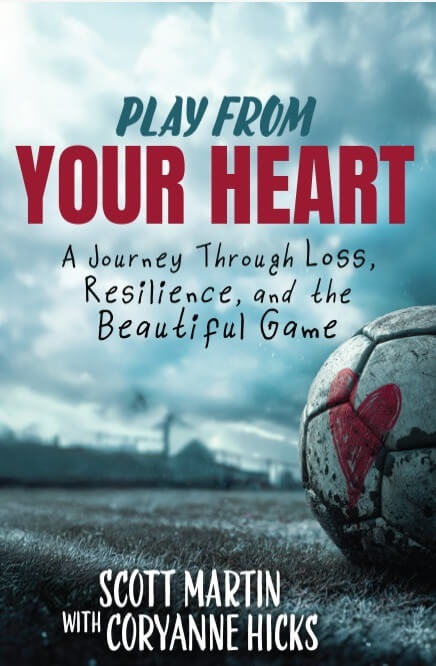
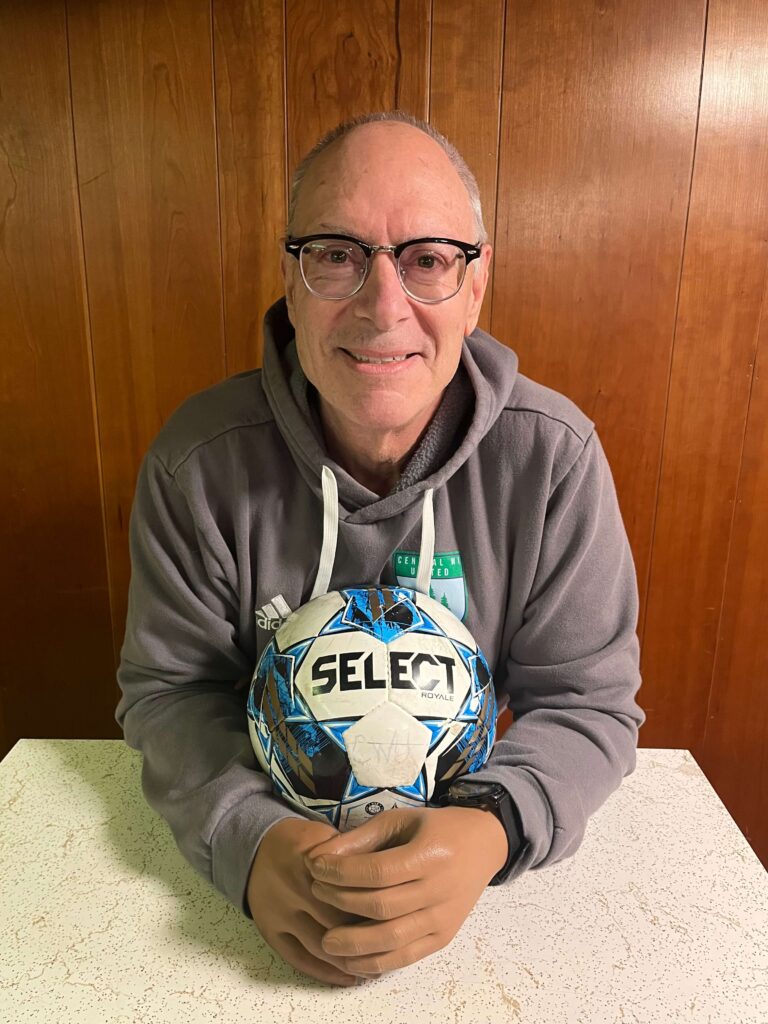
The quote is a puncture to the heart from the first chapter of his book “Play from Your Heart”, an autobiographical tome narrating Martin’s near death shave after being infected with flesh-eating bacteria in 1993 and surviving, but at the cost of his hands and feet. A rising soccer coach, he was slated that day to speak at a Nike regional soccer camp before flying to Europe to train a group of college players before competing in the Holland Cup, the Dana Cup and the Gothia Cup in Sweden.
Instead, Martin spent the rest of a month in a coma and woke up to the news of a different life.
“I went from being a white male in the United States (where) all you had to do was win and have beers with the right people in order to start to move and keep moving up the ladder,” he said. “That totally changed. I went to become a disabled man.”
It took decades, entailing a long bout with severe depression, a medical malpractice trial, an initial attempt to lead a nationally ranked soccer program before taking a step back for his mental health and adopting five children from Romania and Ethiopia for Martin to “come to grips” with his new life.
“With what I can and cannot do, what I might need help with and limitations,” he said. But the acceptance has become a liberation – “It has freed me up emotionally to be able to go back and be more of myself,” he continued.
With a raw honesty, Martin bares it all in his autobiography, detailing day-by-day the road from the hospital bed to rehab, from being introduced to prosthetics to his first encounter with being discriminated against.
His autobiography is currently available for presale and due to be published on June 9, 2026. Eager readers can find a link to his book here.
“That man with no hands touched me!” reads the dialogue of a girl who bumped into Martin in a university hallway corridor, shortly after his return to work as a hall director and head soccer coach.
“I felt inept and isolated. I was an outsider. A campus freak,” Martin described feeling at that moment, in his book.
It wouldn’t be the last. Martin spoke to facing discrimination, whether it be while seeking jobs or while on the field, shaking the hand of the opposing coach before a match.
“They would pull back and I could tell what was running through their mind,” Martin said. “I’ve got a disabled guy here and he’s not going to know anything about the game.”
To Martin, this became an advantage.
“(I’d think) well that’s when I got you,” he said. “Because I know that’s how you’re playing it. And that’s probably going to happen to your players as well.”
Prior to his infection, Martin described himself as “cocky and free thinking.” “I always wanted to explore and had a hard time taking no for an answer,” he said. It was that “bullheadedness”, as he phrased it, that got him through the first years living as someone with limb loss.
In the book, and in his interview, he talked about how he figured out how to drive a car using his prosthetics, using a spinner knob. “My hands wouldn’t function fast enough to turn the wheel and it dawned on me to use a spinner knob,” he said. “Take the round knob off it and make a U-shaped handle so I could put my hand in and I’m also holding on to the handle.”
But it was also the same traits that led him into a severe depression that lasted years. “I was my own worst enemy,” he said. “I know that because I didn’t work on my head, I didn’t work on my heart. And that’s what drove me down and smack dab into the brick wall of depression.”
His book delves into how he used work as a “defense mechanism”, denying the new limitations on his life with prosthetics. Martin doesn’t shield away from the raw episodes of his recovery whether that be tearful moments with family, the frustration of legal trial and the emotional exhaustion of having to re-piece his identity in an entirely new social landscape.
The hardest chapters remain the ones about family. “I still feel guilty for what my family had to go through, which sounds ridiculous,” he said. Revisiting his time in the hospital and the choices his family had to make – “we either unhook him and the illness is going to kill him or we amputate and see what happens,” he recalls the choices his mother and brother were left to make over his life – “that’s the thing that makes me most tear up,” he said. Comedy was his go-to to lighten things up and it helped.
“I’d try to make them laugh so they didn’t have to think about it,” he said. “It helped me too.”
In his book, Martin recalled how when he woke up from his coma to see his family standing by his bedside, his first instinct was to “lighten the mood.”
“How do you make a joke when the only thing you can move is your eyelids?” he wrote. “If I started blinking fanatically, they’d probably think I was having a seizure.”
His dad swept in his place, joking that Martin didn’t look so good. The tube in his throat didn’t stop a quip from coming to mind: “I still look better than you, old man.”
His brother Jeff has been helping him with getting “the book ready for publication, but Martin hopes he gets to read it fully once it’s complete and out. For the family, the chapters on the trial may bring up uncomfortable memories – “I asked one nephew, one niece, my sister, brother and mother a couple of questions and their answers are word-for-word in the book,” he said, dealing with his first weeks in the hospital when he was in a coma.
“I let it all hang out in the book because it’s important,” he said. At his home office, behind his desk, hangs a picture of a pensive monkey wearing headphones. The office is where Martin wrote his book and the picture is how he stayed grounded throughout the process.
“He was always around when I was writing and he would remind me to just chill, turn on some tunes,” he said.
There’s music in the book, songs that Martin hopes his readers would pull up on their Spotify and listen to. “It’s up to the individual but they can take a bit of a mind break and listen to a song” that he might be playing during soccer practice, he added.
On one hand, writing the book has been therapeutic for Martin. “It’s allowed me to revisit the stuff from a safe distance,” he said. He doesn’t like looking at mirrors – “I don’t want to see myself like this so I avoid that,” he said. But being able to write the book and talk about has been “helpful”, he added, “so maybe I will come around.”
The book title, “Play From Your Heart” is well-intentioned – it’s the mantra by which Martin coaches soccer today.
“Getting players to play the way they feel,” he summarized. He takes a boombox to training, belting out music from rock and blues to jazz and disco, matching the play to the rhythm. “I’ve backed off even more from what I used to do. I don’t run drills. The game I feel is very creative.”
The style isn’t common in the States where players are used to a step-by-step strategy dictated by their coaches. “Run from disc A to B to C,” Martin recalled, adding that the style is much more free with players coached in Europe. It has meant getting his players to break through a confidence barrier and getting comfortable with a style that isn’t dependent on their coach barking out instructions from the sideline.
Many a time he has encountered a player coming up to him at the end of the season and confessing they had their doubts about him when they first saw him. As the season went on, players would change their minds and often ask to interview him for their college papers.
“Once they get to know me and just become relaxed with a pretty severely disabled person, it’s okay,” he said. They also call him by his first name. “Because we work together,” he said.
Martin described his first introduction with his “soccer rats”, as he liked to call them.
Liam Mast was a curly-haired blonde with braces whom Martin immediately positioned as a central midfielder on the team.
“Here’s the deal,” Martin recalled telling the 12-year-old. “I’m rarely going to tell you what to do but be ready to answer questions. Got it?”
“I’d just given this soccer rat the golden ticket: freedom to explore,” he wrote.
It was a line he’d continue to repeat to all his players with the admonition that they need to speak up for themselves even if they get it wrong. “Because that will build a stronger player,” he said. “By building a stronger person, you’re going to have a stronger player, and then, therefore, they’re all going to play together better.”
Compared to American football, “there’s so much creativity” in soccer, he added, “and there’s so much that can be explored. And I’m giving these players the opportunity to explore. The ones that don’t take it, they’re going to flounder. But the ones that do, that’s when we put something together.”
For a C-team of ‘soccer rats’, the boys would go on to outdo the expectations of other coaches, teams and their families. “They learned how to play like a Jackson Pollock painting,” Martin said.
As for his relationship with his players, Martin said it all came down to being upfront and honest with them, starting with acknowledging the elephant in the room. “We have to cover the basics first and me being disabled,” Martin said. “Once we get past that, and it happens over time with experiences together, laughing together, (messing) around and stuff … it doesn’t matter. Doesn’t matter at all. They see past it.”
Martin is also a father of five children, adopted from Romania and Ethiopia, all of whom came to his household as toddlers.
“At no time did any of them freak out,” he said. Despite their different backgrounds, languages and stories, Martin felt kinship with them.
“I wanted to be with them,” he said. “Be their father, help raise them, because I knew they had things to overcome, just like me. What a great collection of people that was.”
A social studies teacher, soccer coach, parent, disability advocate and now author and podcaster, Martin’s mission is simple: “Not to teach you but to put you in a position to learn.”
That applies not only to his kids on and off the field.
“We perceive ourselves through others rather than through ourselves, and that’s wrong because we can’t be mad at others for it,” he said. He sees the book as a “responsibility” to bring community to those living with a disability, and to also “educate the non-disabled.”
He referred to three students he once passed in a hallway, two in a wheelchair and one missing a hand.
“Maybe that girl (missing a hand) will feel a little better because she saw me in the classroom,” he said. “But I’m just being my goofy self, playing music while I’m substitute teaching and talking with the kids.”
The message he’d like readers to take away from his book? “Let’s not take life too seriously. Because s*** is going to happen,” he said.