

Listen to this Article
Accessibility does not only refer to physical features such as ramps or screen readers. It also includes access to communication, early learning and the supports that allow children and families to participate fully from the earliest stages of development.
The Ask Grandma app was designed to support early language development, but its impact could be much broader. By helping children develop communication skills from a young age, tools like this have the potential to:
Support early detection of communication-related disabilities or developmental differences
Provide a supportive environment that reduces frustration and builds confidence, potentially preventing issues such as anxiety or social isolation
Offer culturally grounded, accessible learning experiences that make early intervention more inclusive and widely available
While Ask Grandma wasn’t created specifically as an assistive technology, its approach highlights how thoughtful, human-centred design in early learning tools can intersect with accessibility in meaningful ways.
Ask Grandma was developed in response to access gaps faced by Indigenous families raising young children in rural and reservation communities. Early learning and early intervention services are limited by provider shortages, geographic distance and long intervals between clinical visits. Dr. Joshua Allison Burbank, a speech-language pathologist serving the Navajo Nation, encounters these barriers in daily practice. His work with families informed the creation of the mobile app designed to extend developmental support beyond infrequent in-person services.
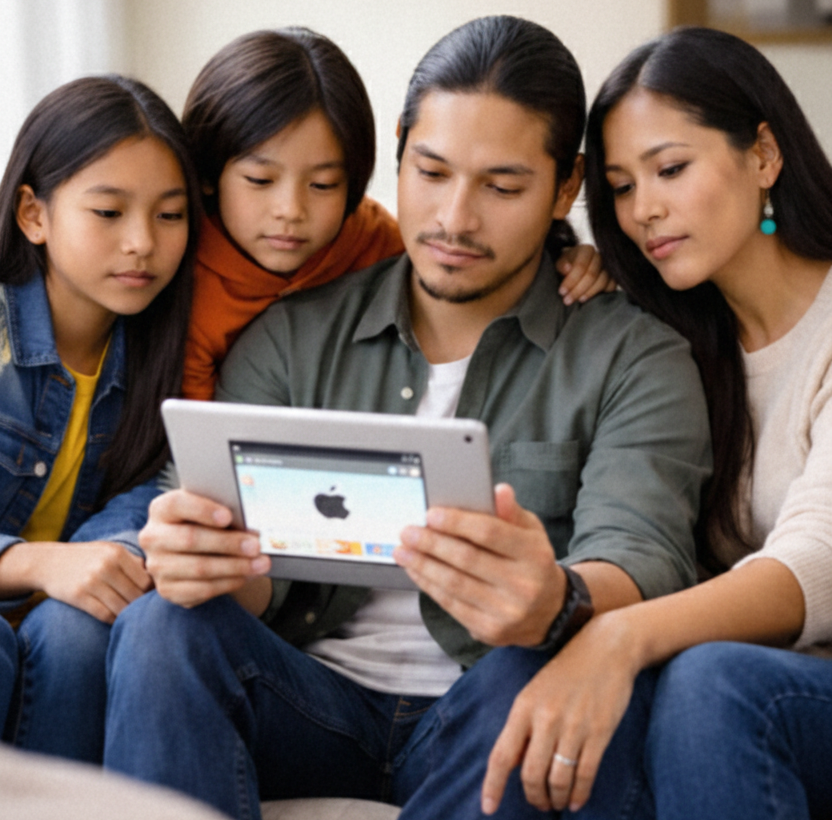
Ask Grandma functions as an early learning and communication support tool delivered through a mobile platform families already use. Parents enter a child’s name and date of birth and receive age-based developmental milestone prompts. The app supports monitoring and tracking of early communication and developmental skills. When children do not meet expected milestones, families can access resources and strategies within the app. This structure allows earlier identification of developmental concerns and reduces reliance on delayed referrals.
Accessibility is a central consideration in the app’s design. In many Indigenous communities, access barriers include limited broadband, travel constraints and inconsistent provider availability. Ask Grandma does not replace clinical services. It extends access to guidance between visits and supports families who may otherwise wait months for follow-up. The app also allows providers to receive alerts when developmental tracking indicates concerns, improving prioritization and early response.
Cultural grounding shapes how accessibility is delivered. Across many Indigenous communities, knowledge related to caregiving and child development is shared through Elders and matriarchs. Ask Grandma uses an AI agent modeled on a grandmother figure who communicates in a nurturing and familiar tone. This approach reflects community-based learning structures rather than clinical instruction alone. Burbank supervises and trains the AI to ensure responses remain evidence-informed and within defined boundaries. The guidance provided is not medical advice and is intended to support, not replace, professional care.
Traditional ways of learning are honoured through integration with everyday routines. Language development strategies are embedded within activities families already value, including cultural events, outdoor activities and home interactions. Rather than isolating exercises, the app encourages parents to model language during familiar moments. Evidence-based speech-language strategies are adapted to fit these contexts, maintaining consistency with clinical practice while improving usability.
Feedback from caregivers participating in field testing in the Southwest indicates that the app fills a practical access gap. Families report using Ask Grandma when providers are unavailable or when online searches feel unreliable. Some describe it as being similar to other voice-based technologies, with the distinction that guidance reflects Indigenous values and parenting styles. Usage data is reviewed by the development team to refine content and improve accessibility features.
Early language support intersects directly with broader accessibility and inclusion goals. Communication affects participation in family life, education and community activities. Indigenous communities experience higher rates of developmental delays linked to poverty, stress and historical trauma. At the same time, fewer early intervention providers serve these regions. Ask Grandma supports accessibility by enabling ongoing developmental surveillance beginning in infancy, allowing earlier identification of risk and more timely connection to services.
Language accessibility also includes cultural and linguistic inclusion. Indigenous languages carry identity, community connection and intergenerational knowledge. Ask Grandma supports bilingual and multilingual development through structured modules that address common misconceptions surrounding language exposure. Families receive guidance on supporting English alongside Indigenous languages. The app reinforces that multilingual development is supported by research and can occur through responsive interaction rather than formal instruction.
The app includes a series of modules called Grandma’s Teachings. These lessons adapt established speech-language strategies such as modeling, following the child’s lead, modifying the environment and allowing pause time. Content is presented through an Indigenous framework that emphasizes relational interaction. One module focuses specifically on dual language development, providing activities and examples families can use immediately. Visual materials feature Burbank and his team demonstrating strategies within community settings.
Indigenous approaches to learning emphasize storytelling, shared experience and relational engagement. Ask Grandma reflects these principles through tone and structure rather than direct instruction alone. Guidance is framed to encourage connection rather than compliance. This approach supports emotionally accessible learning environments for children with communication differences and developmental disabilities.
Culturally grounded tools also influence how families notice early signs of communication differences. By embedding developmental guidance within familiar cultural contexts, Ask Grandma reduces fear and stigma often associated with disability identification. Families are encouraged to observe, reflect and seek support without judgment. This supports earlier engagement with services and aligns with preventive approaches in disability access.
Early learning plays a critical role in accessibility for disability communities. Burbank emphasizes that infancy and toddlerhood represent a key period for language, social development and neuroplasticity. Early intervention does not eliminate disability, but research shows it supports communication, engagement and participation over time. Ask Grandma supports access to early learning during this period, particularly for families who face systemic barriers to services.
The project also demonstrates implications for early childhood systems and policy. Ask Grandma combines Indigenous knowledge, developmental science and technology within an accessible framework. It offers a model for inclusive design shaped by community needs and supervised by clinicians. Burbank identifies the project as an example of how Western evidence-based practice and Indigenous ways of knowing can coexist within accessibility-focused tools.
At its foundation, Ask Grandma emphasizes connection. Indigenous teachings frame well-being through relationships with family, community and environment. Developmental delays and disabilities can affect those connections. Through consistent guidance, culturally grounded language strategies and accessible technology, the app supports families in maintaining and strengthening engagement.
Ask Grandma operates as a support tool within existing systems rather than a standalone solution. By expanding access to early learning and communication support, it reframes accessibility to include culture, language and belonging as integral components of disability inclusion.