
Listen to this Article
Martin Block co-created Able Rise, a site that is focused on providing people with disabilities and their loved ones a supportive space while educating those without disabilities about what it’s like to live in an inaccessible world
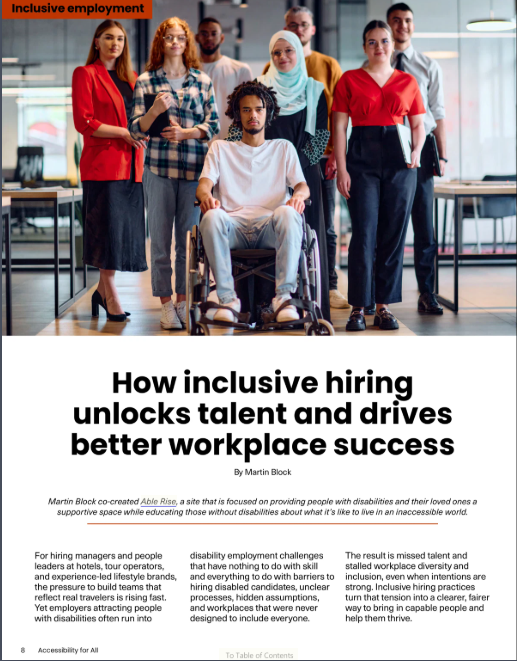
For hiring managers and people leaders at hotels, tour operators, and experience-led lifestyle brands, the pressure to build teams that reflect real travelers is rising fast. Yet employers attracting people with disabilities often run into disability employment challenges that have nothing to do with skill and everything to do with barriers to hiring disabled candidates, unclear processes, hidden assumptions, and workplaces that were never designed to include everyone. The result is missed talent and stalled workplace diversity and inclusion, even when intentions are strong. Inclusive hiring practices turn that tension into a clearer, fairer way to bring in capable people and help them thrive.
What Inclusive Hiring Really Means
Inclusive hiring means designing your recruiting so every qualified person can take part and be taken seriously. A practical inclusive hiring approach makes applications, interviews, and onboarding accessible and welcoming, not just “open to all” in theory. It also sits alongside disability employment laws, which set the baseline for fairness and reasonable support at work.
This matters because the people serving guests shape whether travel and lifestyle experiences feel safe, respectful, and usable. When teams include disabled talent, businesses often see stronger retention, better day-to-day problem solving, and a culture where asking for what you need is normal.
Think of accessible recruitment like step-free entry to a boutique hotel. You can have great design, but if the front door blocks people, the experience never starts. A consistent recruitment process removes friction so skills can shine. With the basics clear, simple process upgrades and accommodation budgets become easier to prioritize.
12 Structures, Benefits, and Incentives You Can Implement This Quarter
Inclusive hiring becomes real when it shows up in your job posts, your interview flow, your tech stack, and your budget, not just your values statement. Use the ideas below to make accessibility the default, so more people can apply, do their best work, and stay.
- Rewrite job descriptions for accessibility and clarity: Start with the essential outcomes of the role (what success looks like in 30/60/90 days) and separate them from “nice-to-haves” that quietly screen people out. Use plain language, define acronyms, and avoid requirements like “must lift 50 lbs” unless it’s truly core, then describe alternate ways to meet it. Add an “accommodations welcome” line with a direct contact method, and publish the pay range to reduce guesswork.
- Make applications low-friction (and screen-reader friendly): Test your application form with keyboard-only navigation and confirm it works with common assistive technology, including screen readers and speech-to-text. Offer at least two ways to apply (form plus email, for example), and avoid timed assessments by default. If you use pre-screen questions, keep them short and job-relevant, three to five questions is plenty.
- Revamp recruitment processes to reduce bias (and track outcomes): Standardize interviews using the same core questions for every candidate, score answers against role criteria, and train interviewers to focus on skills, not “culture fit.” Build accountability by using a simple dashboard to track outcomes like pass-through rates at each stage; patterns often reveal where barriers are hiding. This also supports the “retention and supportive culture” upside by showing candidates you take fairness seriously.
- Budget reasonable workplace accommodations up front: Put a small, clearly owned line item into your quarterly plan so accommodations aren’t treated as an exception or an emergency. Create a one-page request process: who to ask, what info is needed, and a response timeframe (for example, acknowledge within 2 business days). Include flexible scheduling, quiet workspace options, remote/hybrid agreements, and travel adjustments for offsites, important if your team works in travel, lifestyle, or events.
- Check assistive-technology compatibility in everyday work tools: Audit your core workflow, chat, documents, calendar invites, training videos, and internal portals, for captions, alt text, and keyboard accessibility. Set a standard that any new internal tool must meet basic accessibility requirements before purchase, not after complaints. This helps disabled hires contribute fully on day one and saves your team from “retrofit” chaos later.
- Build internship programs and early-career pathways for disabled candidates: Partner with disability community groups, university resource centers, or local workforce programs to create paid internships with defined projects and a mentor. Offer multiple formats, remote, part-time, and project-based, so candidates can balance health needs, mobility, or transportation. End each internship with a skills map and a concrete next step: a return offer, a referral, or a structured portfolio plan.
Strengthen inclusive company culture with visible, practical signals:Establish meeting norms that help everyone: agendas sent 24 hours ahead, notes shared after, and camera-optional video calls. Normalize self-advocacy by having managers share how to request support and by celebrating process improvements (like better captions) as the team wins. When culture matches policy, accommodations feel routine, not risky. - Strengthen inclusive company culture with visible, practical signals: Establish meeting norms that help everyone: agendas sent 24 hours ahead, notes shared after, and camera-optional video calls. Normalize self-advocacy by having managers share how to request support and by celebrating process improvements (like better captions) as the team wins. When culture matches policy, accommodations feel routine, not risky.

Inclusive Hiring Questions, Answered Simply
Q: What specific workplace adjustments can employers make to create a truly inclusive environment for employees with disabilities?
A: Start with a private, employee-led conversation about barriers and job outcomes, then offer a short menu of options like flexible hours, remote participation, ergonomic setups, captions, or a quieter workspace. Document the agreed supports, owner, and review date so it feels routine, not personal negotiation. Keeping accessibility built into everyday tools reduces last-minute scramble and helps performance shine.
Q: How can employers ensure their recruitment process does not unintentionally exclude candidates with disabilities?
A: Remove friction by making applications keyboard-friendly, screen-reader compatible, and available in more than one format. Standardize interviews with skills-based scoring and allow candidates to request adjustments without having to disclose medical details. Since 16% of the global population experience a significant disability, accessibility is a talent strategy, not a niche effort.
Q: What types of benefits and incentives are most effective in supporting new hires who have disabilities?
A: Prioritize benefits that reduce uncertainty: paid time for medical appointments, flexible scheduling, accessible travel arrangements for offsites, and a clear accommodation budget. Add practical supports like a home-office stipend, transit help, or assistive-tech reimbursement when needed. Make the request process simple and predictable, with a guaranteed response timeline.
Q: How can companies promote ongoing support and reduce feelings of overwhelm for new employees with disabilities?
A: Offer a paced onboarding plan with smaller milestones, written expectations, and a single point of contact for questions. Schedule brief check-ins that focus on workload, tools, and communication preferences, not just performance. Many teams find that rules to promote fairness in hiring and promotions have a positive impact on the workplace, which can normalize support for everyone.
Q: What opportunities are available for individuals with disabilities who feel uncertain about their career path and want to gain practical IT skills remotely?
A: Look for remote-first pathways that are structured and portfolio-based, such as guided certificates, project sprints, or apprenticeships with clear skill checkpoints. Choose programs that support accessibility needs, offer flexible pacing, and provide feedback from mentors or peers. A practical next step is to pick one job family (QA, support, data, or web) and build 2 to 3 small projects that demonstrate real workflow skills, or explore a computer science bachelor’s degree. Small, documented supports create big confidence, and that is where inclusive workplaces start to win.
Inclusive Hiring Actions to Complete This Week
This checklist turns good intentions into repeatable habits, so inclusive hiring stays as practical as packing smart for accessible, low-waste travel. Use it to remove barriers early, reduce stress for new hires, and build a workplace where more people can contribute fully.
- Audit application forms for keyboard, caption, and screen-reader access
- Publish an adjustments request option in every job post
- Standardize interviews with skills rubrics and consistent questions
- Set a reasonable accommodation budget with a response deadline
- Build accessible defaults into tools: captions, templates, and quiet options
- Document agreed supports with owner, timeline, and review date
- Track onboarding feedback and fix one friction point monthly
- Small steps, locked in, create real belonging.
Turning Inclusive Hiring Into Stronger Teams and Workplace Outcomes
Even well-meaning workplaces can miss great candidates when systems aren’t built for access, support, and follow-through. A community-first workplace mindset, grounded in inclusive employment motivation and consistent support for disabled employees, turns intent into everyday practice. When that happens, the benefits of employing people with disabilities show up in retention, morale, problem-solving, and clearer workplace diversity outcomes that people can actually feel. Inclusion isn’t charity, it’s a talent strategy that strengthens the whole workplace. Choose one change to start this week and one policy to formalize this month, so progress doesn’t depend on who happens to be hiring. That steady commitment builds workplaces with more resilience, trust, and belonging for everyone.