





Listen to this Article

What first drew you to scuba diving, and how did that journey evolve into adaptive diving and accessibility?
What first drew me to scuba diving was an early and very personal fascination with the ocean. I grew up watching documentaries by David Attenborough and the ocean explorations of Sylvia Earle, and I remember being completely drawn into underwater worlds through productions like Blue Planet. It felt like another universe that I needed to experience for myself rather than just observe from a screen.
A defining moment came during my teenage years at Puri Beach Orissa India, when I was unexpectedly pulled underwater by a strong wave. For a few seconds I genuinely thought I might not resurface. That moment stayed with me because it revealed both the power and unpredictability of the ocean, but also how quickly things can change when you are not aware of water safety and conditions. It planted an early awareness in me about respect, preparedness, and the need for stronger coastal safety systems.
As I later travelled to places like Bali, Sri Lanka, Rio de Janeiro, and Pattaya, I began noticing something that I could not ignore. I would often see people with disabilities sitting at the shoreline, close to the water but never in it. That visual stayed with me more than anything else. It raised a simple but uncomfortable question in my mind about why access to the ocean was still so limited.
Over time, scuba diving became more than exploration for me. It became a space of reflection and connection. My training and certification by the Handicapped Scuba Association helped me understand how transformative diving could be when accessibility is built in rather than added later. That is when my journey naturally evolved into adaptive diving. It was no longer just about experiencing the ocean, but about ensuring others could experience it too, with dignity, safety, and independence. Accessibility became not an initiative, but a responsibility shaped by lived experience and observation.
What does adaptive scuba diving look like in practice, and how does it differ from traditional dive training?
Adaptive scuba diving in practice is best understood not as a separate form of diving, but as a more personalised way of teaching the same core skills. The goal is identical for every diver, which is safety, confidence, and independence underwater. What changes is the pathway to get there, shaped by the individual’s physical, sensory, or cognitive needs.In this process, the role of the instructor, dive master, and trained buddy becomes central to the entire experience. For a diver with a disability, they are not just supervisors, but essential enablers of safe participation from the very beginning of the journey.
This support begins on the surface itself, from assisting safe transfer onto the boat, to ensuring comfortable and dignified movement from wheelchair or seating systems into full dive preparation. Every step is handled with care, coordination, and prior training, so that the diver experiences confidence rather than dependence.
Once in the water, their role shifts to continuous supervision, positioning, and real-time safety support, allowing the diver to focus fully on the experience underwater. The objective is always to maintain independence wherever possible, while ensuring safety and comfort at every stage of entry, descent, and exploration.
This collaborative system is what makes adaptive diving truly inclusive, where responsibility is shared and trust becomes the foundation of the entire dive experience.
Working with frameworks developed by the Professional Association of Diving Instructors and the Handicapped Scuba Association, I have seen how structured flexibility can create meaningful access. Training is not standardised in a rigid way. Instead, it is broken down, adapted, and rebuilt around the diver’s abilities. Some divers may require one-on-one support, while others progress toward full independence with minimal assistance.
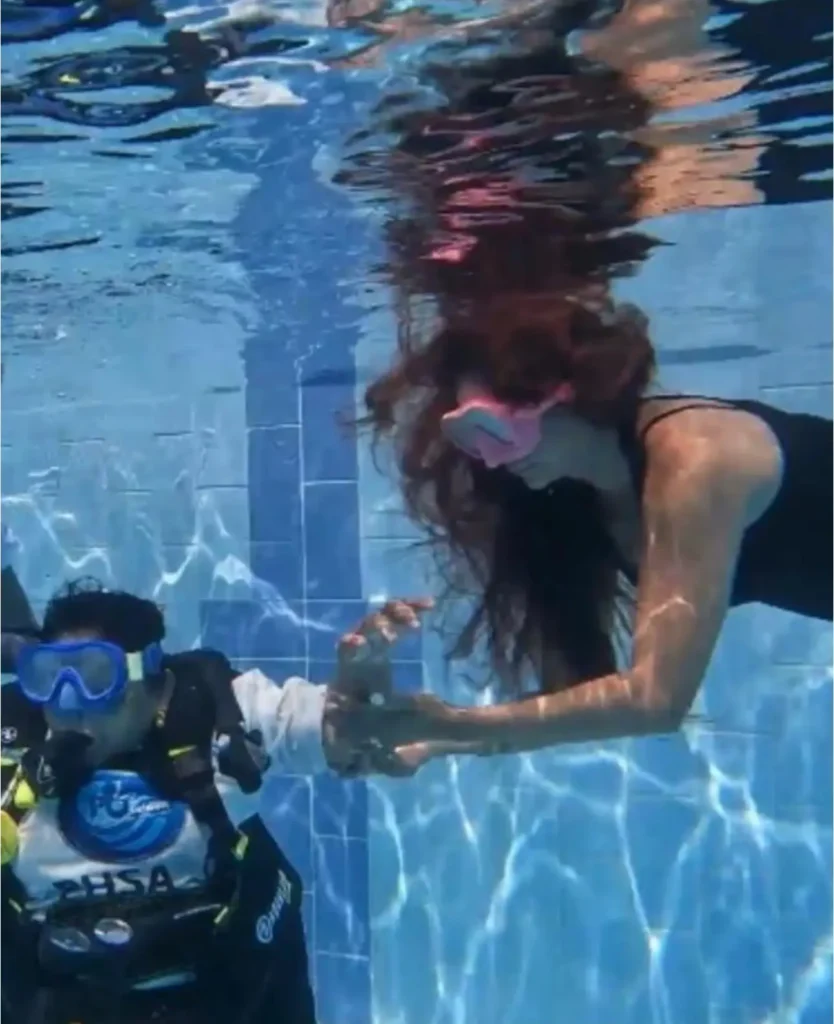
What stands out most is the environment of patience and trust. Skills are not rushed. They are built through much repetition, reassurance, and adaptation. Something like buoyancy control may be taught differently depending on whether a diver uses fin movement or relies more on breath control and weight distribution. A skill like mask clearing might be broken into smaller steps or supported temporarily by a buddy until confidence develops.
There is also a strong rehabilitative and psychological dimension. Research in diving medicine and adaptive sport science shows improvements in confidence, motor coordination, respiratory control, and overall wellbeing when diving is approached inclusively (Buzzacott & Denoble, 2018; HSA, 2020). But beyond data, what I witness most is transformation in identity. People begin to see themselves differently in water. They are no longer defined by limitation but by capability.
The most important difference from traditional training is philosophical. Traditional instruction often asks whether a person can meet a standard. Adaptive diving asks how the standard can meet the person. That shift changes everything about how learning happens and how inclusion is experienced.
How do you define meaningful inclusion underwater?
Meaningful inclusion underwater goes far beyond access. It is not enough that someone can enter the water. The real question is whether they feel they belong there with dignity, confidence, and equality.
Through my experience, I have seen how diving impacts not just the body, but the mind and identity. Research consistently shows that exposure to blue spaces like the ocean can reduce stress and anxiety while improving emotional wellbeing and cognitive balance. This is especially significant for individuals living with both visible and invisible disabilities, including neurodiversity, PTSD, and mental health conditions.
My work with adaptive diving has shown me that inclusion must be emotional as well as physical. A diver is not just learning skills. They are rebuilding trust in their own abilities. That shift, from hesitation to confidence, is often the most powerful transformation that happens underwater.
Meaningful inclusion is also deeply connected to rights and ethics. The United Nations Convention on the Rights of Persons with Disabilities clearly states that participation in cultural, recreational, and leisure activities is a fundamental right. That includes ocean access. So inclusion is not an added benefit. It is a matter of equity.
For me, the most important part of inclusion is identity. A diver with a disability should not be viewed through the lens of limitation, but as a diver first. They should be supported where needed, independent where possible, and always treated with respect and agency.
When this happens, the ocean becomes more than a physical space. It becomes a shared human experience. That is when inclusion becomes real, not theoretical. It moves from access to belonging, and from participation to empowerment.
What are some common misconceptions about divers with disabilities?
One of the most persistent misconceptions is that divers with disabilities are fragile or unable to safely manage the demands of diving. This assumption is not supported by evidence. In fact, studies in diving medicine and adaptive sport science show that with proper training and safety protocols, individuals with disabilities can participate safely and often experience significant physical and psychological benefits (Divers Alert Network, 2017).
Another misconception is that diving is purely a physical activity. In reality, it is equally cognitive and emotional. It requires focus, awareness, decision making, and trust in both equipment and environment. Many divers with disabilities develop strong adaptive awareness and resilience precisely because they approach the experience differently.
There is also a widespread lack of understanding around invisible disabilities. Conditions such as anxiety, autism, PTSD, or neurological differences are often not recognised in recreational spaces. Yet research increasingly shows that structured diving environments can support emotional regulation, confidence building, and attention focus in such individuals.
A further misconception is that adaptive diving is a simplified or less demanding version of diving. This is incorrect. The standards remain the same. What changes is the teaching method. Skills are adapted, not reduced. In many cases, the level of awareness required can be even higher because of the need to integrate multiple systems of movement, communication, and environmental awareness.
From my perspective, the real misconception is not about ability. It is about perception. The issue lies in how systems have been designed, not in the capability of the individuals participating.
Changing this narrative requires moving from a deficit based understanding of disability to a capability based framework. When that shift happens, inclusion becomes natural rather than exceptional.
light, credible citations naturally within the flow.
How do adaptive diving programs maintain safety while allowing flexibility?
Safety in adaptive scuba diving is something I never treat as negotiable. In fact, the entire foundation of inclusion underwater rests on how strong and structured the safety systems are. What changes in adaptive diving is not the standard of safety itself, but the way that safety is achieved through personalised methods.
Before the dive begins, we follow a structured pre-dive protocol to ensure complete safety and preparedness for every diver with a disability. This includes a valid medical certification and physician clearance confirming fitness to participate in scuba diving activities. We also require appropriate disability documentation, where applicable, to help the dive team understand specific needs and plan support accordingly. In addition, a detailed disclaimer and informed consent form is signed by the diver and, where necessary, by parents or legal guardians to ensure full transparency of risks and responsibilities. This process allows instructors and dive professionals to design a safe, personalised approach even before training begins, ensuring both dignity and safety are prioritised from the very first interaction.
Organizations such as the Professional Association of Diving Instructors and the Handicapped Scuba Association have developed structured frameworks that ensure divers are assessed, trained, and supported through clearly defined safety protocols. Every diver begins with medical screening, followed by individualized risk assessment that considers both physical and psychological readiness.
What I have observed in practice is that safety becomes even more intentional in adaptive diving. Dive planning is more detailed, communication is more precise, and buddy systems are strengthened through specific training. Assistants and instructors are not improvising underwater; they are working within carefully designed systems that have been refined over decades of diving medicine and practice.
Research from organizations such as the Divers Alert Network also supports the fact that individuals with disabilities do not show increased incident rates when proper protocols are followed (Pollock et al., 2017). That evidence is important because it shifts the conversation away from perceived risk and toward managed risk.
Flexibility is introduced only in the method, never in the outcome. A skill like buoyancy control or regulator recovery is still required, but how it is taught may differ based on ability. This aligns with broader principles in adaptive education and motor learning, where repetition, modification, and feedback improve both safety and skill retention (Burgstahler, 2015).
From my perspective, safety in adaptive diving is not just technical. It is also emotional. A diver who feels supported and understood is far more likely to remain calm, focused, and responsive underwater. That psychological safety becomes part of the overall system.
Ultimately, adaptive diving proves that structure and flexibility are not opposites. When designed well, they strengthen each other.
Share an example of adapting a scuba skill?
One of the clearest ways to understand adaptive diving is through real skills that are adjusted rather than replaced. A simple example is mask clearing. In traditional training, a diver uses both hands, tilts the head, and exhales through the nose to clear water from the mask. But in adaptive diving, this same skill may be broken into smaller steps or modified depending on the diver’s mobility or comfort level.
For someone with limited hand function, the instructor may work with one-handed techniques, or introduce gradual water exposure until confidence builds. In some cases, a trained buddy may provide stabilization during the early stages of learning. The goal is never to change the outcome, only the pathway to achieving it. This approach is widely used in programs such as those developed by the Handicapped Scuba Association.
Another example is buoyancy control, which is one of the most important skills in diving. For divers with lower limb paralysis, traditional fin-based control may not be possible. Instead, training may focus more heavily on breath control, body positioning, and weight distribution. Some divers may also use hand propulsion or assistive equipment like scooters when appropriate. Research in adaptive motor learning shows that breaking skills into structured components and repeating them with feedback significantly improves mastery and confidence (Burgstahler, 2015).
What stands out to me in these moments is that adaptation often increases awareness. Divers become highly conscious of breathing patterns, balance, and environmental feedback in ways that are sometimes more refined than in traditional training.
The most important principle is that no skill is removed. It is always re-engineered. That re-engineering is what allows independence to grow at the pace of the individual rather than the limitation of a system.
For me, these moments underwater are not about modification. They are about transformation.
What role do dive buddies and instructors play?
Dive buddies and instructors are truly the foundation of adaptive scuba diving. Without them, inclusion underwater would not function in a safe or meaningful way. But their role goes far beyond assistance. They are trained collaborators in safety, communication, and trust.
In structured systems such as those developed by the Handicapped Scuba Association and aligned with standards from the Professional Association of Diving Instructors, instructors are trained to observe, interpret, and adapt in real time. They learn to break down complex skills into manageable steps while maintaining full safety standards throughout the dive.
Dive buddies are equally important. They are trained to maintain positioning, monitor non-verbal cues, and assist only when necessary. Their role is not to take control but to ensure stability while allowing the diver to progress independently. In many cases, this balance between support and autonomy is what makes the experience successful.
What I find most powerful is the relationship that forms underwater. It is not hierarchical. It is collaborative. The instructor provides structure, the buddy provides responsiveness, and the diver leads their own journey. This creates what I often describe as a triangle of trust.
Research in adaptive sport environments shows that structured buddy systems significantly improve confidence, skill retention, and safety outcomes for participants with disabilities (Buzzacott & Denoble, 2018). But beyond research, what I witness is human transformation. People begin to trust themselves again in environments they once thought were inaccessible.
From my perspective, this role also reflects a deeper shift in how we understand inclusion. It is not about doing things for someone. It is about creating systems where people can safely do things for themselves.
When that happens underwater, the impact is lasting. It changes how a diver sees the ocean, but more importantly, how they see themselves.
What gaps still exist in adaptive diving today?
Despite meaningful progress in adaptive scuba diving, there are still several structural gaps that limit true global inclusion. One of the most visible challenges is infrastructure. Many dive centres and coastal destinations still lack basic accessibility features such as adapted entry systems, accessible boats, or inclusive changing facilities. Research in accessible tourism consistently shows that physical infrastructure remains one of the biggest barriers to participation (UN Tourism, 2024; Darcy & Buhalis, 2011).
Another major gap is the shortage of trained adaptive instructors. While organizations like the Handicapped Scuba Association and the Professional Association of Diving Instructors provide frameworks, the number of certified professionals remains limited globally. This creates uneven access depending on geography, meaning inclusion is often dependent on where a person lives rather than their ability or interest.
There is also a communication gap within the dive tourism industry. Many dive centres do not clearly communicate accessibility or inclusive diving options on their platforms. This lack of visibility unintentionally excludes divers with disabilities and their families, even when services may technically be available. Studies in inclusive tourism marketing show that representation and visibility directly influence participation decisions (Darcy & Dickson, 2009).
A deeper systemic gap lies in perception. Adaptive diving is still often treated as a niche offering rather than a standard part of ocean tourism. This limits investment, funding,training, and long-term planning.
From my perspective, the most important gap is not capability but implementation. The knowledge, training systems, and frameworks already exist. What is missing is consistent prioritization and integration into mainstream diving culture.
Closing these gaps requires more than awareness. It requires structural change, industry accountability, and a shift in mindset from accommodation to inclusion as a default.
What changes are needed in the global dive industry?
The global dive industry is at a very important turning point. Diving today is no longer just about exploration or recreation. It is part of a much larger conversation around accessibility, sustainability, and responsible tourism. Yet the pace of change within the industry is still slower than the reality on the ground demands.
One of the most urgent changes needed is infrastructure level accessibility. Many dive centres around the world still operate without accessible boats, modified entry systems, or basic inclusive facilities. Research in accessible tourism shows that when physical barriers are removed, participation increases significantly, not just for individuals with disabilities but for entire travel groups including families and caregivers (UN Tourism, 2024; Darcy & Buhalis, 2011).
The second major shift required is mainstream professional training. Adaptive diving should not remain a specialised niche certification. It needs to be integrated into standard dive instructor development pathways. While organizations such as the Professional Association of Diving Instructors and the Handicapped Scuba Association have already developed strong frameworks, global adoption is still limited. This creates unequal access depending on geography, rather than need or interest.
There is also a communication gap that the industry often overlooks. Many dive operators do not actively communicate accessibility options on their websites or marketing platforms. This invisibility sends an unintended message that diving is not for everyone. Research in inclusive tourism communication shows that visibility plays a critical role in travel decision making, especially for travellers with disabilities (Darcy & Dickson, 2009).
Another important shift is the integration of sustainability and inclusion. Inclusive diving aligns naturally with broader environmental and social responsibility frameworks, including SDG 14 on life below water. When people with diverse abilities are included in ocean experiences, they often become stronger advocates for conservation and stewardship.
For me, the future of diving is not about creating separate spaces. It is about redesigning existing systems so that inclusion is built in from the beginning. The tools already exist. What is needed now is intention, investment, and industry leadership willing to treat accessibility as essential, not optional.
Other considerations
What I feel is still missing in the global conversation around adaptive scuba diving is a recognition of its broader potential. It is often seen only through the lens of recreation or tourism, but in reality it can become something far more integrated and impactful. It can connect education, employment, conservation, and even community resilience in ways we have only begun to explore.
One of the most powerful possibilities is the development of global citizen science and ocean inclusion networks. These could bring together divers, researchers, students, and trained adaptive diving professionals to contribute to reef monitoring, biodiversity mapping, and coastal conservation. Research in citizen science shows that structured public participation significantly strengthens environmental data collection and long-term conservation outcomes (Fritz et al., 2019; UN Ocean Decade, 2021).
There is also an important opportunity in inclusive employment within marine and dive tourism. Globally, over 1.3 billion people live with some form of disability according to the World Health Organization. Yet participation in adventure tourism remains disproportionately low due to structural barriers. This is not about ability. It is about design. When dive centres begin to adopt inclusive hiring and training practices, they do not just create jobs, they shift culture at an operational level.
Another area that deserves attention is how adaptive diving skills can support broader community preparedness. Skills such as underwater communication, risk awareness, and controlled response systems could be extended into coastal safety and disaster preparedness training, especially in vulnerable regions. Studies in disaster risk reduction highlight the importance of trained local responders in improving emergency outcomes (UNDRR, 2022).
From my perspective, what we need now is a shift from isolated programs to integrated systems. Universities, youth networks, and ocean institutions must become active participants in this movement, not just observers. When students engage directly with inclusion based fieldwork, ocean literacy becomes lived experience rather than theory.
Ultimately, the ocean has never been exclusive. It is our systems that have been. And if we redesign those systems thoughtfully, inclusion stops being an initiative and becomes the foundation of how we engage with the sea.
For me, that is the future worth building.